07 August 2011

Omar m'a tuer/Omar Killed Me


"This film is based on a true story" as one write or say in connection to a movie (or a book), based on an actual event, more or less modified.

In this case we follow a Moroccan immigrant - Omar Raddad - and his fight for justice.
An elderly woman - Ghislaine Marchal - is found dead in her house, in the basement, bathing in blood. This happening in a small town called Mougins.
On a wall she has written(?) the above title of the film, only that when writing this in French in the form "has killed me" or "killed me", it's not written like that but (in French): "Omar m'a tué". As she was a cultivated and educated woman, the suspicion whether or not she had written this should be raised.

As a gardener she - and a neighbour - had employed Omar Raddad and the police, knowing that he is Moroccan, fear that he will leave France wherefore they search him and find him.
From this on Omar Raddad is entangled in a legal fight for his honour, as he claims not having killed this woman.

People are chocked by the event and they need a scape goat and what better one than Raddad, being an immigrant, not having learned the French language sufficiantly to be able to plead for his cause and seemingly not interested in integrating himself in the French society.
Initially there are many circumstantial evidences pointing at him but there are also a great deal of uncertainty around some factors, if one are willing to see them.
The things talking against Omar was that he had debts, caused by a gambling habit, and that he - according to the film - had asked Mme Marchal money in advance.
A journalist takes an interest in his case and he is defended by Jacques Vergès a well known lawyer although somewhat controversial.

The film takes us back and forth through both the legal process and its different legal quibbles, M. Haddad's hopes and despairs, his family's worries and their hopes and despairs but also the different tokens of xenophobia or even racism and how this affected the way one looked upon Omar Raddad and his guilt or innocence.
Thanks to a petition for his release and the fact that the government has made a deal between Morocco and France concerning prisoners, Raddad is released prematurely.
From this day, he starts his own fight to clear his name, among other things asking for a DNA test of the blood and other traces at the crime site, in order to determine if these traces came from him or not.
This fight is going on to this day as the French judicial system has denied access to the results of these tests and the posibility to compare them with known criminals.

It all seems as a clear case of abuse of justice, Omar Raddad being a victim, firstly of the fact that he is a 'foreigner', secondly that he was not regarded being 'integrated' in the French society, thirdly that he had debts (like most people in the world in one way or another), fourthly that he gambled and didn't seem to be a 'responsible' person.
If he actually is the guilty person or not? Who knows more than him and the victim, the latter not able to witness from the other side.

I think that the film displays all these different aspects in a clear and, at the same time, disturbing way, without to much plunging into a sentimental mise-en-scéne and acting, as had more been the case had the film been made in USA.
Sami Bouajila in the role as Raddad is very convincing and one can feel his frustration almost in a tangible way.

Director is actor Roschdy Zem.


(Poster copied from: http://a35.idata.over-blog.com/375x500/4/01/99/77/Juin-2011/Omar-m-a-tuer-affiche.jpg)

(Photo Omar Raddad copied from: https://blogger.googleusercontent.com/img/b/R29vZ2xl/AVvXsEiE4ht-JPuWWi3wyCof6kZFs6m6BYMx29v99SMYlorOk2WbJp8V1wmABQn_GI82o1Im3goheYD0D_KUYqmaXTxEroppEkCDZMFDHo-CR7zIR7uti9dJyEEydMG_dqasLB0HG6xz/s1600/09WIB_Omar-Raddad.jpg)
06 August 2011

Le Soupirant


Another film from the - in our opinion - brilliant director Pierre Etaix
This time we also get to hear some Swedish spoken in the film.

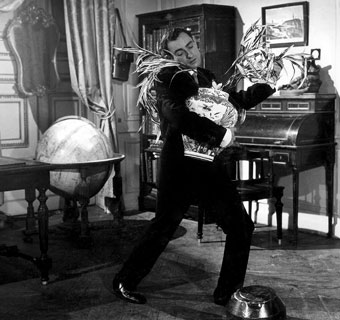
Etaix is the main character (as in most of his films), a young bachelor by the name of Pierre, living with his elderly parents though he since long is a grown up man, at least seen in relation to his age.
He interests himself in astrology and this has become an obsession to such a degree that he is unable to take on an adult attitude to life, living on his own, moving out from his parents house, finding his way in the world.
The only remedy is for him to get married, not least seen from the perspective of his mother. The father in the family doesn't really care, obviously contented with the situation, as long as he's able to smoke his cigars, drink his liquor and listening to the music played by the Swedish maid Ilka (Karin Vesely). All this done in the sly, as his dominant wife doesn't approve of his habits.

In order to please his parents (read: his mother) Pierre initiates his "wife hunting" project.
At first he actually asks the maid if she wants to marry him but as she isn't fluent in French, she doesn't understand his question.
He goes out "into the world" and at first he study other men and how they approach women but he is not lucky at all, until he - at a restaurant - meets a woman whose husband suddenly leaves her alone. This might be Pierre's chance but very soon he understands why the man has left this woman.
The story goes back and forth and at the same time the maid in the house - actually fancying Pierre - becomes more and more fluent in French. Maybe they will be able to reach out to each other?

This is a very amusing film, with a quiet form of humour, rendering the film a higher value as it deals with the problems of communicating, both verbally, emotionally and intellectually and how hard it can be to see what is very obvious in life. In this case discovering that the love of your life stands next to you, without you being aware of it.
In the film, the young Swedish maid, tells a story in Swedish, only understood by me and Aurore, a story about a knight and a virgin meeting but not understanding one another, leading to that they never was given the chance to express their love for one another.
In the film there are a lot of 'gags', reminding of the fact that Etaix has worked with Tati but yet has his own trade mark. We recommend this film!
In other roles: France Arnel, Laurence Lignères, Claude Massot and Denise Péronne.


(Poster copied from: http://www.notrecinema.com/images/cache/le-soupirant-affiche_9349_2944.jpg)
(Photo dancing Pierre Etaix copied from: http://www.cinemas-utopia.org/admin/films_img/img30/2975.jpeg)
(Photo Pierre Etaix among two statues copied from: http://www.critikat.com/local/cache-vignettes/L710xH424/film_le_soupirant_etaix-be408.jpg)

04 August 2011

Kappa no ku to natsu yasumi/Un été avec Coo/Summer Days with Coo


What is a kappa? In Swedish it's a coat but in Japanese it's a legendary creature sometimes described as a water sprite, ressembling - in it's functions - the Scandinavian 'Neck' or 'Näck', the Scottish 'Kelpie', a dangerous figure, able to lure both children and adults into the water, drowning them and taking them to their realm at the bottom of a sea.

In this film we get to meet one of those Kappa's, by the name of Coo. The film starts with him talking to his father about the rice farmers who are planning to use their swamp to create a gigantic rice field.
When the father tries to talk to the samuraï in charge of this, the latter - out of fear for this mythic creature - kills the father and tries to kill Coo too. He doesn't succeed as they both are struck by an earthquake burrying Coo in a cliff crevice making him into a fossil.
Hundreds of years later he is found by a young boy, Kôichi (Takahiro Yokokawa) who brings him home in the fossil stage he is in.
At home Koîchi starts to wash and water the Kappa (as this is obviously the tradition) and suddenly Coo comes alive, at first scaring the whole family. Kôichi's father soon take and interest in the kappa and his mother accepts the presence of this strange 'animal'. The sister however does not at all like the intruder - at first. Koîchi is overwhelmed with delight.
Now follows a time when the Kappa recovers, get to know his 'new family' and as he is able to speak with them they start to discuss what to do in the future, if the Kappa should stay with them or if they should try to find a 'natural habitat' for him. Coo is also an expert in sumo wrestling.
All of a sudden the news are spread that the family have a kappa and they all become celebrities.
The story continues with the search for a new home and at the same time, the attempts to protect the kappa from all the curious people, of whom not all are benevolent towards this newcomer.

Although there are a lot of funny sequences we both thought that the plot is to thin and that the story goes back and forth in a rather boring way using a repetitive pattern when telling the story, making the film appear far too long. Maybe this story more appeal to the Japanese viewers, having other frames of references, whereby they are able to appreciate it more than we did?

02 August 2011

Persona


Persona is a film having been interpreted in various ways depending on what reference system you want to use: An historical, sociological, religious or psychological, perhaps a combination of some of them - or all of them.
One can't add much more to this special and cinematically very interesting film, written during some weeks at the hospital where Ingmar Bergman were recovering from pneumonia. The general impression I (Gunnar) get from Bergman's personality is that he - among other things - was a hypochondriac and during his time in hospital, he probably believed that he would die and it's perhaps this traumatic experience that lead to the writing of Persona.
He has said that succeeding in writing the script to this film, saved his life. This is probably more to be understood in a mental/psychological way than in a physical even though they are more or less connected.
What we can say about the film is that Liv Ullman and Bibi Andersson embarked on a cinematically extremely innovative journey into the 'unknown'. There are, of course, other actors in this film but it's around these two women the story revolves.

The film begins with a multitude of images depicting camera equipments and projectors being lit up. Among the images we can distinguish an erected penis, a crucifixion, some scenes from a comedy, a silent-film reel once seen in Bergman's 'Prison' and finally the slaughter of a lamb. When these images disappear we get to see a young boy - actor Jörgen Lindström (also playing the part of the young boy in 'The Silence') - waking up at a hospital surrounded by corpses and reading Lermontov's 'A Hero of Our Time' (the same book he reads in 'The Silence').
In the background we see some blurry images depicting Elisabet's (Liv Ullman) and Alma's (Bibi Andersson) faces. He caresses them.

In the next phase (from face to phase) we're at the hospital where Alma, a newly graduated nurse is being asked to take care of a patient who doesn't talk.
The patient is Elisabeth Vogler, a famous actress. Alma hesitates but finally accepts 'the mission'.
The superior nurse wants her to continue taking care of Vogler and therefore offers Alma her cottage by the sea where she wants Alma and Elisabeth Vogler to stay for a while, in order to see if leaving the hospital will make Vogler feel better.
Vogler is not regarded as having a psychological disorder, just having decided not to talk anymore (and why shouldn't one have the right to such a decision?).
At the hospital Elisabeth Vogler watches TV and there she is confronted with the horrors of the world making her very upset though she doesn't say anything, just watches with a horrified gaze, seemingly suppressing a scream. Evidentally she is not emotionally shut off but responds as any other human being would or should do, with the exception of not being able to verbalize her agony.

At the island in the cottage, the two women become entangled in each other and not telling all the details about their relationship, one might perhaps interpret their behaviour as follows:

1. Elisabeth Vogler is an intelligent woman, finding that her life at the theater has been superficial, that she doesn't contribute to the improvement of the world. As her only 'persona' is the actress Elisabeth, she can't respond in any other way to the misery in the 'external' world, than by stop talking and communicating with others. Perhaps she has found that she has nothing more to say, neither as an actress nor as a person(a)?

2. Elisabeth Vogler can also be seen as a very calculative person, taking advantage of the perceived naïvity characterising her young protégé or 'nurturer', this in order to heal herself by 'sucking the blood' out of Alma. The 'sucking of blood' is something that physcially occurs in one of the scenes.
In the more psychological sense, she takes advantage of the fact that Alma can't accept the silence without talking, making Elisabeth a very good listener and confessor.
Alma talks, Elisabeth listens and uses the material Alma gives away to tightly bind them together, more and more aiming towards a symbiotic relationship.

3. Concluding that this might be the case one have to ask oneself who is taking care of who and who benefits most of this relationship. Alma gets a chance to talk about the things in life that hurts her. Hereby she, to some extent, is alleviated and at the same time Elisabeth is edified.

4. In this process Alma is taking on the personality of and representing the extrovert and talking Elisabeth when - as in a dream or imaginary sequence - they are visited by Elisabeth's husband (actor Gunnar Björnstrand). Is this a real visit or just one emanating from their collective imagination created by their intimate relationship?

5. When Alma leaves the cottage and take the bus back to town, we imagine that she has become a more mature and experienced woman. This as he has lived through another womans life in a way, at the same time going through a veritable catharsis, an experience the two women share. What about Elisabeth Vogler? Is she 'healed'? Has she started talking or is her behaviour just a mature decision, making it a violation of her personal will trying to change her behaviour.

6. However it's only Alma we see leaving the cottage. Where is Elisabeth or is it Elisabeth who is leaving, taking on another role, namely that of Alma, the nurse, having left the 'real' Alma in the cottage, mute? Is the woman we see the 'vampire', having sucked the blood out of her prey leading the two women to take on the life of the opposite person? The actress has finally found a 'real life'-role to play, being able to go out in the world and face it - without a 'persona'.
This is perhaps the most plausible conclusion.

Bergman pointed out that he had chosen these two actresses as he had seen a photo in a newspaper and there having found a remarkable resemblance between the two.

The film is however a masterpiece in our opinion (and many others too of course).

01 August 2011

Tystnaden/The Silence


Contrary to popular notions, 'Tystnaden' is not a totally quiet film in any sense neither when it comes to dialogue, nor the surrounding environment, the unknown society where the two sisters stay. The silence is perhaps more related to the metaphysical silence of the 'beyond', that is God, who doesn't answer the inner prayers of at least one of the sisters - maybe both - and the little boy, the son of one of them.

Ingrid Thulin and Gunnel Lindblom are two sisters making a journey together, staying in an unknown town in an unknown country or perhaps only unnamed.
Ingrid Thulin's 'Ester' (in some way maybe referring to the Biblical person, after whome 'The Book of Esther' is named?) works as a translator but when arriving in this new country, she doesn't understand the language. This of course makes her somewhat silent in relation to her work, and thereby as a person as she can't express herself through her professional persona. She is also terminally ill, trying to seek the voice of God or a higher being, letting her continue to live and work. This as she obviously feels that she has a lot of unfinished business to attend to in her earthly existence.
Gunnel Lindblom's 'Anna' (the name of 'Saint Mary's' mother) seem to be haunted by the more physical silence, constituted by the unknown town, its inhabitants with whome she can't talk but also by the fact that she is seeking physical love and doesn't seem able to find it.
On the same time there is a gap between the two sisters, a void of silence created by a hierarchial structure between the two, obviously dating back to their childhood but also shifting from time to time depending on who, momentarily, is the strongests of them.
We get hints about their relationship indicating that 'Ester' was the stonger and more dominant person when they were younger but with her currently being very sick, 'Anna' can dominate 'Ester'. That is if this really is the case as the relationship and struggle for power goes back and forth depending on who is able to take advantage of the other person's weakness.
For the young boy - Johan (Jörgen Lindström) - the silence is created by this power struggle between his mother 'Anna' and her sister, creating a tension and uncertainty that troubles Johan. In a way he more relates to 'Ester' than to his mother but on the same time it seems as if his loyalty with 'Anna', in the end becomes predominant though their emotional relationship hardly could be described as warm and confident, as it should or could be between a mother/father and a child.
In all this we can sense an erotic trait between the two sisters, making us discern a incestuous relationship between the two but also an erotic tension between the mother and her son, the son having reached the age when the sexuality have to be explored. Of course we could use a Freudian perspective with the son in love with his mother but this interpretation is so common and obsolete that we can leave it aside.
Through the waiter (actor Håkan Jahnberg), who's helping not least 'Ester' - like 'the Good Samaritan' in the Bible - Johan also find a friend and guide and this is even more intensified when a group of midgets, being a part of a circus, start to play with him. Also in this case we find the erotic perspective when they dress Johan up in women's clothings, until their boss enters the room and call for discipline and respect.

A lot of questions about vertical and horisontal relations are posed in this film - as almost always in the films by Bergman - and the answers, to a great degree, are to be found in each and everyone of us, the viewers, making this and other œuvres by Bergman into an intellecutal and emotional journey through our inner feelings, confronting us with all the sentiments our socialization has hidden within our deepest mental corridors.