Showing posts with label Books. Show all posts

18 June 2011

Plus sombre que l'ombre de tes ailes...

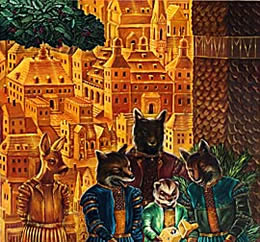
...is the title of a book written by the French journalist and nowadays writer Sébastien Acker, having lived and worked in Berry/Le centre for ten years.
He has always been a bibliophile and as young he read around 4-5 books per week.
When working as a journalist he became fascinated by Swedish and Scandinavian literature and specifically the crime fiction ('polar'), beginning with Sjöwall & Wahlöö.
Later on he continued to interest himself in other authors and more or less incidentally he came to write this book with the above name that - with a rough translation - means: "Much somber/darker than the shadow of your wings".

Acker today (Saturday) visited La Châtre and La Maison de la Presse in order to sign his book. The photo below (published some days later in the newspaper 'La Nouvelle République') shows Acker in the middle - of course - and my wife Aurore to the right, carrying a box of cinnamon buns, something Acker had asked for and through a 'cooperation' between Aurore and me, he was able to enjoy these Swedish delicacies. Part of the deal with the cinnamon buns was that he promised to carry the yellow shirt of the Swedish football team and below you can see that Acker also kept his part of the deal. (The text in French under the photo)

(DÉDICACE. Sébastien Acker était à la Maison de la presse, samedi matin, pour dédicacer son premier ouvrage Plus sombre que l'ombre de tes ailes aux éditions La Bouinotte. Sébastien avait tenu son pari en revêtant le maillot de foot de l'équipe suédoise ; Aurore, une Castraise, mariée à un Suédois, venue faire dédicacer son livre, avait apporté des kanelbullars, brioches suédoises à la cannelle.)

The events in the book take place both in Berry/Le Centre and Stockholm wherefore Aurore contacted Acker through Facebook, in order to talk about Swedish and Scandinavian literature and parenthetically the links between me and the implicit main character in the book - not mentioned by name - Stieg Larsson, among other things.

The book circles around Léonard, a Parisian postman (always ringing twice?) who is a huge fan of Scandinavian crime novels but also a (very) private investigator, working for noone and nothing.
When having finished the reading of a world famous Swedish crime novel (guess which one), he becomes convinced of one thing: To him it's clear that the author of this crime novel, dying before he get to see the success of his books, as a journalist threatened by the extreme right wing groups in Sweden, was murdered!
Léonard plonges into this certitude. How can it be that everyone believes that the author of this blockbuster actually died from a heart attack?
Our postman starts his first own major private investigation, flanked by Léon a disabled colleague.
To the Stockholm of Mysteries from Berry, the two men experience a surprising adventure, taking them from places like The Old Town in Stockholm to the province of George Sand, from The Blue Tower in Stockholm, where August Strindberg lived to Sainte-Sévère and Jacques Tati's 'Jour de Fête'.

Below an interview in French by Bip tv, (Berry Issoudun Première Télévision), where Acker explains a little about himself, his passion for Scandinavia and his own book.


Sebastien ACKER


(Photo cover copied from: http://livreaucentre.fr/files/2011/03/plus-sombre.jpg)

(Photo Acker and Aurore at La Maison de La Press in La Châtre copied from: http://www.lanouvellerepublique.fr/indre/LOISIRS/Livres-cd-dvd/D-233-clic19)

11 March 2010

Institut Suédois, John Ajvide Lindqvist, Jenny and Elin

At 8.52 we left Châteauroux train station, heading towards Paris. Arriving 10.52.
Got the keys to cousin Hervé's appartment.
Leaving our bagage there and then wandering around Paris this sunny, somewhat windy afternoon.
Have they cleaned up some parts of the town?
Lunching at a Japanese restaurant, talking Chinese with the waiter.

A visit to SI (L'Institut Suédois), getting tickets to the event this evening=The film 'Låt den rätte komma in' ('Morse' en français and 'Let the Right One In' in English) by Tomas Alfredsson and a discussion with the author John Ajvide Lindqvist.

Then followed a rendez-vous with my charming first cousins once removed Jenny and Elin both of them living and working in Paris, one having lived here for ten, the other for fifteen years.
Jenny works as a make-up artist within the couture industry, Elin as a designer of clothes. Both doing very well within their domains.
This is the first time I meet my first cousins... - ever!
Aurore and I spent two very nice hours with them!

After this back to SI with questions, answers and magic with and a signature by John Ajvide Lindqvist (below) and a dinner with cousin Hervé and friends ending at 01.30.


28 November 2009

Aux frontières du génie chez George Sand

Today at the museum in La Châtre - partly dedicated to the author George Sand - we visited a lecture with the above title: 'At the borders of genius of George Sand' or in French:

"Une heure, une œuvre au Musée de La Châtre : "Aux frontières du Génie chez George Sand". Conférence sur une œuvre du musée George Sand et de la Vallée Noire, animée par le Docteur Baum et Franck Lloyd"

Psychiatrist, doctor Baum and teacher and director Frank Lloyd, talked about the bipolarity (bipolar disorder) George Sand had to struggle with.
I write "struggle" but her bipolarity was, according to these two gentlemen, in part also an explanation to her enormous creativity and explains how she managed to achieve so many things in her life. This mostly during her manic periods of course.

Besides writing almost 70 novels, she wrote novellettes, stage plays, fairy tales, literary critic, autobiographies and some 20 000 letters, that is to say 3-4 letters per day at an average.
The person to whom she wrote most frequently was Alfred de Musset.

She also helped other writers and musicians as being their foremost patron, friend and maecenas. Many of them should, perhaps, not even have survived without her help.
Among the men around her we found Frédéric Chopin, Eugène Delacroix, Victor Hugo, Alexandre Dumas, Honoré de Balzac and many others.
Of course she also had female friends, of whom we, unfortunately, know less.
She is said to have had at least 19 lovers, of both sexes.

Among both past time generations and contemporaries she was and is considered being a feminist although she didn't characterise herself as such.
Besides her extensive writing, socializing and her engagement in the welfare of other writers and musicians, she also engaged herself in politics, although not within a specific political organisation.

In the audience (the museum totally filled up with people) there were a great number of people knowing the works and life of George Sand very well and a quite vivid discussion came about.

As being a Swede, I would like to say that George Sand deserves becoming more well known as a writer in Sweden. Most Swedes know her as the muse of Frédéric Chopin and as a rather marginal writer. This picture need to be revised.


George Sand. Confidences de la Dame de Nohant
envoyé par efiestas. - Découvrez plus de vidéos créatives.


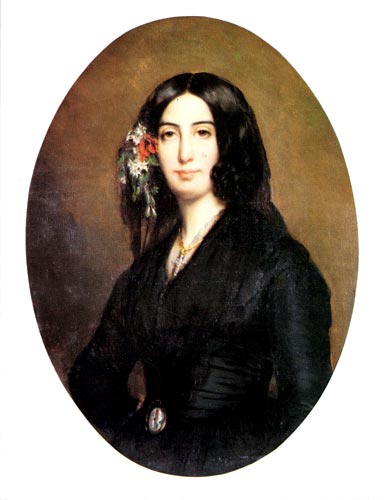
(Picture of George Sand copied from: http://thebsreport.files.wordpress.com/2009/06/georgesand.jpg)


23 July 2009

La Mare au Diable

In front of the "Devil (or Devil's) Pool", a mystic place described in one of George Sand's novels with the same name, in French, as above: La Mare au Diable.
In the novel the main characters walk around this pool or puddle in circles, again and again not finding their way home or their way from this particular spot. A sort of haunted place!
La Mare au Diable - The Devil Pool - wasn't as frightening as one could imagine. Maybe it's more frightening during the night?

audio version (in French).

ebook

23 April 2009

spx09

To prepare Small Press Expo in good conditions, we asked Freddie Kaplan to pick up some comics dealing with the main themes of this year's edition: autobigraphies and friendship.
Gunnar and I got to read:

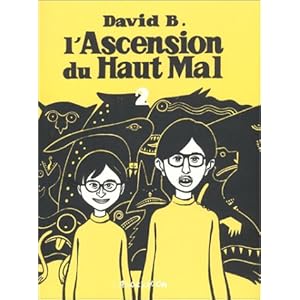
L'Ascension du Haut Mal, by David B. (about his brother's epilepsy)


Black Hole, by Charles Burns (about dysphoric teenagers in the 1970's)

Fun Home, by Alison Bechdel (about her coming out and her father's suicide short after)

Ett Familjealbum, by Åsa Grennvall (the story about her family told by its members)


Gaskriget, by Fabian Göranson (a Swedish backpacker's autobiography)


The Invisibles, by Grant Morrison (about a bunch of super/anti/heroes)


676 apparitions, by Patrice Killoffer (about his neurotic stay in Canada)


(Photo book cover 'L'Ascension du haut mal' copied from: http://ecx.images-amazon.com/images/I/518R9GKQ8XL._SL500_AA300_.jpg)
(Photo book cover 'Black Hole' copied from: http://ecx.images-amazon.com/images/I/519%2BtqG7nxL._BO2,204,203,200_
PIsitb-sticker-arrow-click,TopRight,35,-76_AA300_SH20_OU01_.jpg)

(Photo book cover 'Fun Home' copied from: http://ecx.images-amazon.com/images/I/5124ZCAH9VL._BO2,204,203,200_
PIsitb-sticker-arrow-click,TopRight,35,-76_AA300_SH20_OU01_.jpg)
(Photo book cover 'Familjealbum' copied from: http://image.bokus.com/images2/9789188334848_large)
(Photo book cover 'Gaskriget' copied from: http://www.skolshoppen.se/bokinfobild.php?id=139004)
(Photo book cover 'The Invisibles' copied from: http://photo.goodreads.com/books/1167349033l/22401.jpg)
(Photo book cover '676 apparitions' copied from: http://www.google.com/images?q=676+apparitions+patrice+killoffer&oe=utf-8&rls=
org.mozilla:sv-SE:official&client=firefox-a&um=1&ie=UTF-8&source=og&sa=N&hl=sv&tab=wi&biw=1024&bih=578)

27 March 2009

Grimoire, KaosMateria

Yesterday, we opened a package coming from Denmark.
In it we found a new version of the Grimoire (in French!).
Gunnar spent a part of the evening browsing it (still don't know if that's the correct verb).
We could admire the new changes and strongly recommend this digital book (CD) if you are interested in non linearity, webdesign and much more.
Please take a glimpse on the KaosMateria webpage here.

28 October 2008

Jakten mot Nollpunkten

There are artists that cannot talk about their art.
And some who can, and who even WRITE.
Carl Johan De Geer is among those.
As his self biography was about to be released, he animated a monologue at Hedengrens.
Though we arrived rather early, the bookstore was overcrowded with whisky people between 70 years of age and death.
We had to sit on the last row and do our best to hear everything that was told (forgetting our senile neighbours who talked for themselves, and so on...).
The meeting with de Geer was entertaining and intellectually stimulating, something quite rare in this city.
Even though we sometimes have different opinions concerning people, Gunnar and I respect Carl Johan De Geer since he gives us this rare jewell of the human mind: reflection.

10 February 2007

Jussi Ojala, Marianne Lindberg De Geer, Carl Johan De Geer & K.G. Nilsson


Svenska (English below):


Aurore och jag börjar idag med vernissage hos Konsthantverkarna som bland mycket annat visar upp konstverk av Jussi Ojala med temat 'Från Kontroll till Kaos'.
Han arbetar i keramik och har här bl.a. ställt ut ett antal 'vaser' eller 'krukor' som föreställer vad han kallar 'stubbar' eller 'stammar'.
Det är avhuggna sådana föreställande olika trädslag men att användas som krukor. Även ett par väggdekorationer i keramik. Intressant.

Förutom Ojola finns en rad olika konstnärer representerade vilkas konstverk/bruksföremål är gjorda i alla möjliga material.

Vägg i vägg ligger 'Galleri Helle Knudsen' som idag har vernissage med konstnärerna Marianne De Geer-Lindberg , Carl Johan De Geer, K. G. Nilsson och Ann Makander.

Det är inte många verk som ställs ut men konstnärerna själva finns på plats.
Sparsmakat där kanske inte de mest namnkunniga (för mig mest kända) hade de intressantaste verken att visa.
Aurore tyckte mycket om Marianne De Geer-Lindbergs konst. Det fanns också textil konst av Makander som jag (Gunnar) tyckte mycket om.

Akademibokhandeln blir nästa anhalt och där skall Fredrik Lindström (språkforskare men mest känd från tv:s programserier 'Bästa språket' och 'Världens modernaste land') samt brodern Henrik Lindström berätta om den bok de skrivit tillsammans: 'Svitjods undergång och Sveriges födelse' (eller som jag också läst: 'Folkungarnas undergång och Sveriges födelse').

Som titeln indikerar handlar det om hur vårt land gick från en löst sammahållen enhet till det nationalstatliga Sverige, en process som tog ett antal hundra år.

Man visar bl.a. på alla de slumpmässiga eller till synes slumpmässiga faktorer som bestämde vem som kom att gå till eftervärlden som enare av Sverige eller som pådrivande kraft i riktning mot en enhetlig statsbildning.
Frågor som varför just det vi idag kallar Stockholm kom att bli huvudstad och inte Uppsala eller någon av de tongivande städerna på västkusten diskuteras också.

Ett antal mer eller mindre kända kvinnor och - företrädesvis - män och deras inflytande dissekeras - inte så mycket i föreläsningen som i boken.

Härefter Cinemateket och filmerna 'När lammen tystnar' av Jonathan Demme, vilken knappast tarvar närmare beskrivning, utgår jag från samt 'Careful' av Guy Maddin.

Har ni aldrig sett Maddins filmer och är cineaster, vill jag varmt rekommendera er att se dessa. De är berättade med stumfilmsliknande teknik där bild och ljud bearbetats för att låta patinerat. Dessutom är hans historier mycket speciella blandandes historiska berättelser med sagoliknande innehåll.
Hänvisar till IMDb i ovan angivna länkar för en beskrivning.


English:

First of all we start with a gallery called 'Konsthantverkarna' where we look at a vernissage with works by the Finnish artist Jussi Ojala with the theme 'From Control to Chaos'.

He works with ceramics and in this exhibition he has made 'flower pots' or 'vases' in the shape of cut off tree trunks. Interesting. Besides his art there are works of other artists exhibited too, using all kinds of material. The pieces of art can also be used and are made like every day articles if you can afford them.

Adjacent to this gallery there is another one called 'Gallery Helle Knudsen' where there is a vernissage with art from the more well known artists Marianne De Geer-Lindberg, Carl Johan De Geer (IMDb on Carl Johan De Geer), Ann Makander and K.G. Nilsson among others.

There are few works displayed but although I have seen these artists before I have never seen the pieces of art displayed here today. Aurore very much liked the works by Marianne De Geer-Lindberg. So did I, but also some of the works by Ann Makander.

After this we set out towards The Academy Book Store where a well known Swedish linguist - Fredrik Lindström - and his brother(?) Henrik is going to talk about there book 'The Fall of Svitjod and the Birth of Sweden' (my translation).
This book tells - or try to tell - the story about how the loosely 'merged' country called Svitjod became the Sweden we know today, why Stockholm became the capital instead of one of the influential cities on the West coast or Uppsala.

We conclude the day at the Cinematheque by watching the films 'The Silence of the Lambs' by Jonathan Demme, a film that needs no presentation and 'Careful' by Guy Maddin.

Maddin is a very special film maker.
His themes are a combination between more or less reality based stories and 'sagas', stories resembling them made up by the brothers Grimm for example.
He is very interesting and personal in his realisation of his visions and for those of you who are cinephiles, I warmly recommend him.

CAREFUL: Movie Trailer. Watch more top selected videos about: Movie_Trailers, Careful, Guy_Maddin


(Jussi Ojola-stubbe till vänster ovan kopierad från: https://blogger.googleusercontent.com/img/b/R29vZ2xl/AVvXsEi0mdSBOaBKogSnUoKAzZPdGdu9YEoLYjvjwxLizov86qhgKyi7OQ-eJWS4i-6-LQg6YJDXuoo-L8gnJuQX6otd1TESCdWr6igh5Rch3mMM-XlkQnodg-RF20cGKAJt6SC25sBhmQ/s320/jussi+ojala.gif)

(Jussi Ojola-stubbe till höger ovan kopierad från: https://blogger.googleusercontent.com/img/b/R29vZ2xl/AVvXsEh8WGGeBr1IAkqyhCwzT8BjTAKOI3HM20IYzxngEucRSOxPTQaArTsvxKDujkGuKD28pgH7cNdK_zj1swWNycQPq7CRstTgC5N5A9mtdXL2yOX5rXWZqg0__qJmWV8x1U9PiwMeqw/s400/jo233-8.gif)
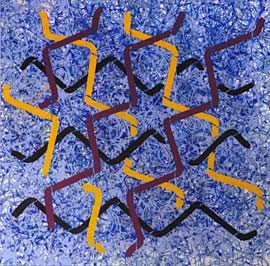
(Konstverk av Ann Makander med icke-linjära mönster koperad från: http://www.omkonst.com/Bilder06/makander.jpg)
(Bokomslag 'Svitjods undergång och Sveriges födelse' kopierad från: http://image.bokus.com/images2/9789100107895_large_svitjods-undergang-och-sveriges-fodelse)

27 January 2007

En fläkt av färg och Arabia Felix

Svenska: Hedengrens bokhandel har idag en utställning som skall pågå en tid med bilder från Indien tagna av Ulla Nordfors, en kvinna som arbetat som fotograf i över 40 år.

Aurore och jag besöker Hedengrens, både i syfte att bese dessa bilder och att leta efter bl.a. Larousses stora 'matbibel';
Larousse gastronomique.

De bilder Nordfors tagit är, i motsats till många skildringar av Indien mycket färgrika och speglar hennes resor i detta land.

Hon var - förra vintern - under två månader gäst hos Tamilnad Christian Council i Chennai.

Innan hon anlände dit hade hon rest runt och besökt platser i Indien som, såvitt hon kunde utröna, ej drabbats av katastrofer.
Detta för att kunna spegla ett annat Indien med det 'vanliga' indiska livet presenterat i bild.
Av de 4000 bilder hon tog har hon här låtit presentera 25 fotografier (se dem här).

Efter Hedengrens går Aurore och jag till
Akademibokhandeln på Mäster Samuelsgatan. Där berättade Eva Sohlman, journalist, om sin bok Arabia Felix i terrorns tid. Resor i Jemen.
I denna bok förtäljer Sohlman historien om sin resa i
Jemen - utsänd av The Economist och Reuters - där hon bl.a. intervjuade landets president Ali Abdullah Saleh, premiärministern Abdul Qader Bajamal och några av de många mäktiga shejkerna.
Till detta kom att hon som kvinna lyckades få tillgång till, som man uttrycker det i förtexten, "kvinnornas tysta och osynliga värld".

De frågor hon försökte få svar på rörde landets kontroversiella samarbete med USA i dess kamp mot terrorismen och hur detta påverkade människors syn på landets oberoende alternativt beroende av USA.
Förutom de många inflytelserika personer hon kom i kontakt med intervjuade hon även den 'vanlige' medborgaren och inte minst kvinnorna.

Som kvinna gavs hon nämligen möjlighet att komma i kontakt med det som bekrivits som (ovan nämnt) kvinnornas 'tysta och osynliga värld'.

I ett land med starka patriarkala styrelseformer både i det offentliga och privata livet, ges sällan kvinnorna möjlighet uttrycka sina åsikter om politik eller livet i allmänhet i den Jemenitiska staten.


Förutom att vilja belysa ovan nämnda områden i samhällslivet var även ambitionen att utforska
Usama bin Ladens rötter i Jemen, det land i vilket han föddes.
I syfte att nå detta mål sökte hon bl.a. upp de av hans släktingar som fortfarande bor kvar i landet.


Eva Sohlman är journalist, född 1972 och har under fem år arbetat för Reuters nyhetsbyrå, baserad i London och Stockholm. Hon har som journalist arbetat med frågor som kultur, energi, miljö och politik och hennes artiklar har publicerats i bl.a. The New York Times och The Washington Post.
Hon har även arbetat med utrikesnyheter på
Sveriges Radios Eko-redaktion och idag är hon stationerad på tv 8 där hon är redaktör för utrikesmagasinet Världen i Fokus.

English:

At Hedengrens bookstore there is an ongoing exhibition with photographs taken by the Swedish photographer Ulla Nordfors, who has worked as a photographer for more than forty years.

Aurore and I visit Hedengrens both for this purpose and in order to find Larousses' great 'Bible of food', Larousse gastronomique.

The photographer Ulla Nordfors has travelled India seeking areas where, as far as she has been able to find out, there has not been any catastrophy of any kind.
In this way she tries to show another India, beyond political crisis, religious conflicts and natural disasters and poverty. She tries to depict the 'normal' life in India.
For two months she was a guest at the Tamilnad Christian Council in Chennai.
The pictures at display is very colourful and it makes us perhaps look att India in another way and hereby the title: 'A Waft of Colours'. She took more than 4000 photos but there are only 25 at display in this exhibition (See them here).

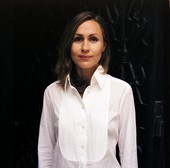
After the visit at Hedengrens bookstore, Aurore and I continue to the Academic Bookstore where a Swedish journalist, Eva Sohlman (photo above), talked about her latest book called 'Arabia Felix in time of Terror. Travels in Jemen' (my translation).
'Arabia Felix' means of course 'The Happy Arabia'.

In this book she tells the story about her travels in Jemen between 2003-2005 as a correspondent for The Economist and Reuters.

She interviewed the President, Ali Abdullah Saleh and Prime minister, Abdul Qader Bajamal of Jemen and many of the influential sheiks.

As a woman she was also given admission to the "quiet and invisible world of Women", as it is described in the book.
These women gave their view on this strictly patriarchal society.

Sohlman also hade the ambition to seek out the roots of Usama bin Laden in this his native country and in doing so she succeeded in finding some relatives to bin Laden still living in Jemen.

Eva Sohlman is a journalist, born in 1972.
She has during five years worked for Reuters news agency based in London and Stockholm.
As a journalist she have covered areas like culture, energy, environment and politics and her articles have been published in The New York Times and Washington Post among other newspapers.
She has also worked with international news at the Swedish Radio's Editorial and she is today editor for the International Magazine The World in Focus at tv channel 8 in Sweden.


(Photo Hedengrens bokhandel copied from: http://euroshop.nu/img/Hedengrens.png)
(Book cover copied from: http://mobil.hd.se/multimedia/archive/00140/arabia_felix_jpg_140744d.jpg)

(Foto Eva Sohlman kopierad från: http://media.bonnierforlagen.se/forfattarfotonstandard/c/20237C.jpg)

15 November 2006

Det rena landet & Sommarkvällar på jorden

Hedengrens lunchunivesitet är ett återkommande inslag i denna förnämliga bokhandels 'evenemangslista'.

Här kan man möta författare som talar om sina verk, oftast nyutgivna, där de mer i detalj förklarar bevekelsegrunderna för tillkomsten av boken ifråga, detaljer i det litterära verket samt även ger åhörarna möjlighet till frågor efter avslutad presentation.

Denna punkt i Hedengrens verksamhet är ett välbesökt evenemang.

Tyvärr - om man skall uttrycka sig så - är det fortfarande en dominans av kvinnor och fr.a. kvinnor i medelåldern eller övre medelåldern. Dessa bär ju upp kulturlivet men visst vore det trevligt se fler yngre åhörare och fler män. Inte minst då dessa 'tillställningar' kan fungera som ett 'miniuniversitet' där man faktiskt kan lära sig mycket om sådant man inte tidigare kände till.

'Kulturtanten' - som hon kallas - är beundransvärd och dessa kvinnor (och i vissa fall män och då blir det väl 'kulturgubbar' - som jag 46 år gammal?) måste nog vara bland de mest allmänbildade personerna i vårt samhälle. Dock en försummad kraft i det samhälleliga livet på olika plan.

Denna gång var det Maja Hagerman som berättade under rubriken 'Svensk rasforskning och svenska härkomstmyter'.
Hagerman är författare och vetenskapsjournalist.
Boken ifråga heter Det rena landet. Om konsten att uppfinna sina förfäder.

Frågan hon ställer i denna bok är varför just Sverige kom att bli en spetsnation inom rasforskningen i början av 1900-talet.
Svaret eller försöket till svar på denna fråga skildras ur ett brett perspektiv som sträcker sig från romarriket under århundradena efter Kristi födelse till Sverige i skuggan av andra världskriget.


Hon visar hur det gick till då både vetenskapsmän, konstnärer och författare skapade eller försökte skapa bilden av svenskarna som ett folk vilket skulle ha en unik härkomst historiskt sett.

Hagerman berättar alltså i viss mån 'förhistorien' till det som senare skedde i Sverige, nämligen upprättandet av det rasbiologiska institutet med tillskyndare som Arthur Engberg, ecklesiastikministern samt läkaren Herman Lundborg och hans rasbiologiska 'forskning'.
Om detta senare skede i den svenska rasbiologins historia, kanske Hagerman berättar i sin nästa bok?

Sommarkvällar på jorden av Gunnel Lindblom är dagens film på Cinemateket.

Filmen tar sin utgångspunkt i en solig sommardag då tre systrar tillsammans med männen till två av dem, modern till systrarna samt barn träffas för att umgås och äta gott.

Under ytan bubblar det dock av frustration, värderingsmässiga skillnader, konflikter, triangulära förhållanden (om man kan uttrycka det så).
Dessa kommer så småningom till ytan med destruktivitet som en ibland oundviklig följd.
Ansvar, kärlek, erotik, lögn och sanning är de teman som behandlas i och med de inblandades handlingar.

Aurore arbetar i filmvisningsrummet ('maskinrummet').


(Foto Maja Hagerman kopierat från: http://bilder.panorstedt.se/bilder/person/224/Hagerman_Maja_1.jpg)
(Foto 'Det rena landet' kopierat från: http://www.majahagerman.se/bilder/detrenalandet1.jpg)
(Photo Gunnel Lindblom taken from: http://content6.flixster.com/photo/11/07/11/11071148_tml.jpg)

14 October 2006

Qin and Hush...Hush, Sweet Charlotte

At the Academy Bookstore today Cecilia Lindqvist talks about her latest book - 'Qin'.
For those of you not knowing who Lindqvist is: She is a sinologist and one of Swedens foremost connoisseurs of the Chinese history and culture.

Qin is the name of a string instrument played in ancient China by the wealthy classes.
As with most wealthy classes around the world, before WWII, they were educated and brought up reading poetry, playing different kinds of instruments and so forth.
The instrument was never used in any other context than within a small circle of highly educated and wealthy people.
When they were trained to become masters of others and lead a province for example, they were left very much on their own and the instrument functioned in making their everyday life less lonely.

The music was not only therapeutic but became a substitute for human relations and they also composed their one music.

When the educated leaders in different societal functions came together they performed their music for one another and discussed it.
They also discussed the instruments, how old and well preserved they were and so on and so forth.

After this I visited the gallery Åmells in Stockholm and took a brief look at Swedish contemporary art by mostly well established painters like Jockum Nordström, Ernst Billgren, Ola Billgren, Lars Englund, Jan Håfström and many more.

Cinemateket next: Hush... Hush, Sweet Charlotte by Robert Aldrich with among others Bette Davis and Olivia de Havilland (se video below).

This movie begins in the late 1920:s in a big mansion at a party where a man get's killed and Bette Davies rôle figure is accused of the murder after a fight with the murdered man.

Many years later we find her living alone with a female 'servant' hidden to the world because of the accusations towards her, even if one never could prove her guilty.

The town now wants to expropriate her ground in order to build a road and they try to make her move out of the house but she refuses.
Her cousine (Olivia de Havilland) arrives for a visit. They haven't seen each other for years, not since the murder. Her cousine was also among the guests at the time of the above mentioned party.
She wants to help Davies but this leads to a conflict with other people involved and a doctor treating Davies cooperates with the cousine but maybe not in benefit of her interests?


(Bild/foto 'Qin' kopierat från: http://melodyrain.blogg.se/images/2010/cimg7288_108427520.jpg)

11 October 2006

Orhan Pamuk Nobelprize winner litterature 2006


Orhan Pamuk (Orhan Pamuk) has received the Nobel Prize in litterature.

This was not particularly surprising as he was one of the candidates most often mentioned this year - and previous years.

Horace Engdahl, the secretary of the Nobel committee, also admits that this is a well-known author and the surprise this year was that their choice did not surprise anyone! A lot of cheering! A political choise? According to the Nobel committee, it is not.

If we retrospectively look at the last ten years laureates though, we find authors who in their authorship clearly take a political stand, if not explicit: Harold Pinter, Elfriede Jelinek, J. M. Coetzee, Imre Kertész, V. S. Naipaul, Günter Grass among others.

This year it happens to coincide with France initiating a legislation against the denial of the genocide of Armenians in Turkey in 1915, an issue Pamuk openely has confronted the Turkish governement with.

Much more could be said but has already been said.


(Photo Orhan Pamuk taken from: http://evan.vnexpress.net/News/Tin-tuc/the-gioi/2009/03/3B9AE3BE/pamuk_pressconf3_photo.jpg)

07 October 2006

Åmells & Charade & The Garage


Vernissage at Gallery Åmells:

Contemporary artists like Ola Billgren, Ernst Billgren, Jan Håfström, Lars Englund, Lena Cronqvist, Jockum Nordström and many more.


In addition to this there were other artists of whom I've never heard.
Aurore didn't visit this exhibition today.

After this we both went to the Academy Bookstore to listen to the author Alexander Ahndoril talking about his book 'The Director' ('Regissören').

This is a novel about a director by the name of Ingmar Bergman and other characters in this book are for example Sven Nykvist, Harriet Andersson, Käbi Laretei, (one of Bergmans wives and a concert pianist), Max von Sydow and so forth.

In spite of this Ahndoril does not want to characterize this book as a biography but rather a novel.

Bergman first became extremely angry and furious "wanting to kill me..." as Ahndoril puts it.
After reading it, one of his first reactions was: "How the hell could you know this. I haven't told anyone about it....". Whether this is true or not is of course hard to determine.

Creating a pseudo biography about one of the most famous Swedish personalities, has of course lead to a great interest in this book, something I pointed out to Ahndoril during the part when we had the opportunity asking him questions about his œuvre.

Unfortunately Ahndoril himself was not a good lecturer, as often is the case with authors.
He didn't seem to be particularly well prepared, either.


Cinema Sture and the film Charade by Stanley Donen with Cary Grant, Audrey Hepburn, Walter Matthau, James Coburn and many more.

This is a movie about a woman whose husband dies in a violent way, not being the person she thought him to be and now confronted with five men who wants money her husband is said to have hidden, thinking she knows where they are.
She meets a mysterious man (Grant) who constantly changes his name and identity but says he wants to help her against the other three men whose only interest is forcing her to give away information she is not in possession of.

A french policeman and a CIA-agent (Matthau) is also involved.
Noone seems to be telling her the truth and she gets more and more confused, not being able to trust anyone.

A most entertaining thriller-comedy. I recommend it for those of you who haven't seen it.

After this 'Garaget ' by Vilgot Sjöman.

A thriller about two men, a principal and a teacher in the same school.
The principal is a man married to a wealthy woman with whom he tries to escape taxation in Sweden by depositing money in a Swiss bank.

This is done with a great deal of assistance from his father-in-law who helps them out economically.

The principal is not happy in his marriage and is engaged in a relation with his friend, the teacher's wife.
She tries to take her life in the beginning of the film but
is rescued by the two men.
Moreover, the teacher has a relationship with a young student though he is a Christian and believer, talking a lot about moral both in his teaching and in his private life. In the latter he is a victim - if I may say so - of deep moral pondering.


The story includes two murder attempts at the woman who is saved in the beginning and these murder attempts are carried out by her husband and the principal. One of them succeeds but the wrong person is convicted.

Moral questions are being presented and discussed and as in real life the ones you think is morally 'chaste and pure' is not.


(Photo painting at the top taken form: The artist and http://www.galleryengstroem.se/gallery/jpggalry/backlnsk.jpg)
(Photo art work by Billgren taken from: The artist and http://www.omkonst.com/Bilder06/billgren1.jpg)
(Photo art work by Englund taken from: The artist and http://www.blaskan.nu/Bilder/lars_englund_i3538.jpg)
(Photo art work by Cronqvist taken from: The artist and http://images.artnet.com/artwork_images_117962_247813_lena-cronqvist.jpg)

30 September 2006

The Trouble with Angels


At one of the so called "Academic bookstores" (Akademibokhandeln in Swedish. The biggest but not the best bookstore in Sweden or Stockholm, as I've written before) in Stockholm I listened to the Swedish writer and professor in History of ideas and learning (if this is the correct translation?) Sven-Eric Liedman talking about his latest book; "Stones in the Soul" (Stenar i själen).

In this book he discusses the question about form and matter from different angles and how it shapes our perception of the World.
It's the last book in a trilogy where he thoroughly penetrates topics that have engaged him for many years. "In the shadow of the Future" (I skuggan av framtiden) was the first book.

After this I went on to see two films at the cinematek: The Trouble with Angels by Ida Lupino and The White Tower by Ted Tetzlaff.

The first film is described as a queermovie dealing with the problems or opportunities two young girls face when they are sent to a convent school with teachers being nuns.
Friendship and underlying homosexual love?

The reality was that this was a light-weight movie about young people in their teens trying to break borders and put the adults to a test in different ways.
A very innocent movie with no queer motif what so ever.

The White Tower with among others Alida Valli, Glenn Ford, Claude Rains and Lloyd Bridges was a pathetic, moralizing lecture about right and wrong and who is always right and who is always wrong.

A woman wants to climb a mountain in Switzerland, a mountain that noone ever has succeeded in climbing. Her father died in trying to do so. She engages five men of whom one is a german with 'übermensch-ideal' who of course, in rejecting help from others, dies.
She gives up her ideals when the 'good' guy - an american of course - gets injured in trying to climb the mountain.
She moves with him to USA despite him having no ideals or aspirations.

27 September 2006

Mahmoud Darwish


Mahmoud Darwish is a Palestinian poet and author who is regarded as the Palestinian national poet. 

Darwish uses Palestine as a metaphor for the loss of Eden, birth and resurrection, and the anguish of dispossession and exile. 
He has been described as incarnating and reflecting "the tradition of the political poet in Islam, the man of action whose action is poetry.".

He also serves as an editor for several literary magazines in Israel.

We had the pleasure listening to him at the Cultural Center in Stockholm (Kulturhuset). He spoke, was interviewed and read some of his poems.

The interesting thing about this last readings, was that one had two Swedish persons reading his poems in Swedish, before he himself read them in Arab.
Although we do not understand Arab, neither Aurore, nor I, we became much more fascinated with his reading then with the Swedish interpretations.

This to a part due to the fact that he read them with ardour and passion, reflecting the content of his writing while the Swedish "interpreters" read in a typically anemic Swedish or Nordic fashion, withouot feelings or the fervor Darwish displayed.

We felt the same thing as we had felt when listening to Adonis the 9th of May this year.

Thanks to Darwish (not the Swedish representatives) this evening became magic.


https://www.babelio.com/users/AVT_Mahmoud-Darwich_2583.jpeg

09 September 2006

Huysmans & Pilsnerfilmer & Imamura

Trying to wake Aurore up. Not an easy task today.

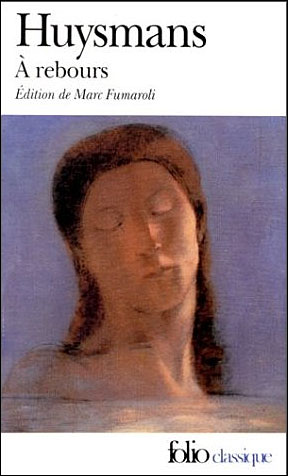
Breakfast, reading Huysmans.

Better weather today but we are 'blowing in the wind...'!

At the Swedish Filminstitute Aurore continues her work while I continue reading about Swedish film from late 19th century til the present day.
Today I concentrate on the 1930:s and among other things the so called pilsner-film(s) ("pilz-movies", beer-movies" or "lager-movies").


This is an extract from one classic 'Pilsner Movie/Film': Pensionat Paradiset

A low-water mark in Swedish film when it comes to quality.
Strangely enough - or not strange at all as one can see similar developments in other countries around the world - these films were very popular with the audience, particularly the working class in Sweden.
One might add, that not all of these films are bad, there are some that are quite watchable. These are better than their reputation but suffers from the overall quality of these œuvres.

From SFI to cinema Sture and the film 'Kuroi ame' ('Black Rain'/'Svart regn') by Shohei Imamura.

This film deals with the aftermath and vast consequences of the atombombs over Hiroshima and Nagasaki.

We follow a family, a young woman and her aunt and uncle when they are hit by the catastrophe and what becomes of them, their internal relations and relations to other people; their health and the constant threat of dying from the long term complications of radiation.
A moving, dramatic film that depicts every person in a way making you taking an interest in and becoming engaged in their individual fates. One of the best films I'v ever seen, depicting this dreadful episode in Japanese history.

Aurore and I than meet in order to go to Systembolaget to buy some wine (Red: 'Oude Kaap', a Cabernet Sauvignon from South-Africa; White: 'Gloria', a Chardonnay from Italy. Another red wine?? Don't remember?).

Dinner at home with Joakim at his 39th birthday.

Rain gutters are being put up at our house.

The Swedish "Watergate-story" with the Swedish liberal party's party leader in one of the leading roles continues. His closest co-workers have trespassed the website of the social-democratic party and hereby they have gotten hold of crucial information not intended for others than the members of the inner circle in the social-democratic party.
Naughty, naughty!!

07 September 2006

Huysmans and Furhammar

Working in the garden. Trying to get our lawn in as good a shape as possible. Talking to a toad I meet where he lies in the grass.

Aurore and I leave our read little house for a visit to the big grey house, the Swedish Filminstitute.
Continuing her research work, I read about Swedish filmhistory.

From there we went on to the art cinema Zita. 
There we saw two short films made by Stefan Jarl:
Epilogue, a film completing(?) the trilogy about Kenta and Stoffe, two men with severe drug problems. These films have become, what one might call, a classic critical survey of the Social Democratic so called Folk's Home or The People's Home (Folkhemmet). This idea not being as beautiful and harmful as it has been depicted by the Party (as convinced social democrats calls it).


Jarl tries to depict their life in three films made in parts during almost three decades.

The second short film: "Cows are fine" (Kor är fina), is a film about the consequences of our EU-membership seen from the point of view of a small farmer in Sweden.

Continuing my reading of Huysman: À rebours, a fascinating story about des Esseintes, the highly eccentric leading character in the book.


At the Swedish Filminstitute I continue reading about the history of Swedish film (Filmen i Sverige, photo below), a book written by one of our foremost film historians, Leif Furhammar. This is - to date - the best and most comprehensive book about Swedish film.


(Photo cover 'À rebours' taken from: http://multimedia.fnac.com/multimedia/images_produits/ZoomPE/3/8/9/9782070368983.jpg)

(Photo backside 'À rebours' taken from: http://www.images-chapitre.com/ima2/original/701/750701_2878549.jpg)

(Photo cover 'Filmen i Sverige' taken from:http://image.bokus.com/
images/9789175041582_200x_filmen-i-sverige-en-historia-i-tio-kapitel-och-en-fortsattning)