As we have a good friend working at the Nationalmuseum in Stockholm - The Museum of Fine Arts - we were given the opportunity not only to meet her but also having her as a guide on the above mentioned exhibition.
This exhibiton wants to convey an insight in to the fashion the above rulers wanted to be and were depicted in art and how this aimed at strengthen their power and make their compatriotes fear or respect them. It also gave them an aura of being appointed by God, as was the common thoughts and terminology at the time. What one display is the art of "governing through art" and how this also strenghtened the despots and their position among other rulers. The ruler who could afford the greatest artistst to immortalize them, using the most expensive materials, was of course in a way the most powerful. The interesting thing about this exhibition and the guiding by our friend was in part to see all the magnificent pieces of art, the room of Jean Baptiste Bernadotte (Karl Johan) and others but also some of the stories behind the 'staging' of the exhibition.
Three countries with different administrative cultures were to cooperate around this exhibition and it wasn't always they succeeded in doing so in a smooth way. One of the items displayed was three busts representing Napoléon, Alexander I and Jean Baptiste Bernadotte. Napoléon had been placed above the two others and this was not to the liking of the Russians who complained about this arrangement. The museum answered that first of all one have to admit that Napoléon was the most powerful leader of the three at the time and secondly that this is the way "we do it in Sweden". The Russians had to accept it!
Another issue was the questions about insurances for all the different works of art and some wanted very precise assertions about how this was going to be handled, while not always being as rigourous the other way around.
It was however a very interesting exhibition with a lot of extremely fine art and artistic work and when our friend had left us, to continue to work, we took a second look at the 'Staging Power'.
(Picture of Napoléon I taken from: http://blog.goldini.com/images/45737-41649/Napoleon.jpg) (Picture of Alexander I taken from: http://www.svenskhistoria.se/nyhetsbrev/userfiles/image/1809b.jpg) (Picture of Karl Johan/Jean Baptiste Bernadotte taken from: http://nationalmuseum.se/Global/utst%C3%A4llningar/H%C3%A4rskarkonst/bernadotte_282xxx.jpg)
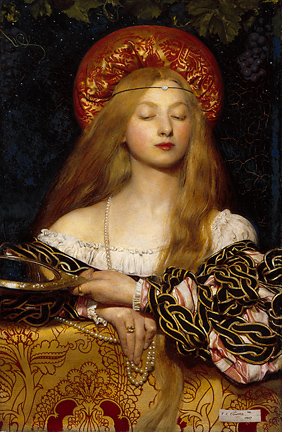
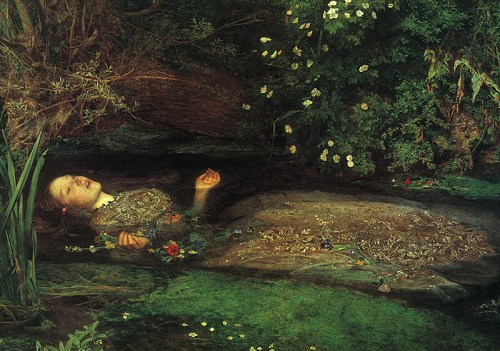
We spent 2h30 enjoying a really good exhitibion. The works of the Pre-Raphaelite Brotherhood that Mikael Ahlund had chosen to show were inspiring: _ they have a special atmosphere _ they are reflexive (dealing with art history, history and modern times) _ they show the artists' skills.
What excited me most was the "end" of the exhibition, where Arts & Crafts, Sub Rosa and Carl Larsson made a fantastic transition to the rest of the Nationalmuseum. Mikael Ahlund and his team succeeded in creating a strong event, inscribing it in the institutional frame. What else could a demanding visitor ask for?
(Photo painting woman at the top of the page copied from: http://www.preraphaelitesisterhood.com/cowper.jpg) (Photo painting Ophelia by John Everett Millais copied from: http://fredfred.net/skriker/images/fred/2005/pre-raphaelites/ophelia-millais.jpg) (Photo painting woman by a loom copied from: http://questionsconcerningreligion.org/images/113.jpg)
The poster was great, the subject was interesting, but the exhibition... less. Or more. This was the problem: there were far too many works, and not all of them were worth their place in the National Museum. With less artworks the exhibition had been a curatorial success: Tight, clever, interesting. With this third extra, it became a cake with too much sugar and too much mediocre chocolate; very difficult to eat.
(Photo boy through a frame copied from: http://www.lakartidningen.se/store/images/7/7545/large/Lura_ogat_1.jpg) (Photo man with the head in a bucket copied from: http://www.onculture.eu/thumbnails%5C425-4.gif) (Photo of woman undressing her skin copied from: http://www.onculture.eu/thumbnails%5C425-2.gif) (Photo papers on a wall copied from: https://blogger.googleusercontent.com/img/b/R29vZ2xl/AVvXsEiRv2GDrPtPMtefNhm0k-pTchzE91HvvaYZ1oIrTdhS8rTLVu2AbULP_OAjR523lIM9qn-gmyRIIk5qavEaKvNqEz5E0FzcqSozWyr57uF28Xo5SIz2viypaP_y8o4gBzSGuj5R/s800/lura_ogat_6764.jpg)
Idag är det franskspråkighetens dag och detta firas bl.a. på Franska instituteti Stockholm med temat serietecknare från både Frankrike, Belgien och andra fransktalande delar i världen. Inte endast Hergépresenteras (fotot nedan) men självfallet utgör han en av de namnkunnigaste illustratörerna som här finns representerade.
Hergé and Tintin
Aurore och jag besöker intitalt Franskat instituet på förmiddagen då vi 'rekognoserar' samt ser en tecknad film med figurerna 'Blake and Mortimer' - för mig en ny bekantskap men seriefigurer Aurore mycket väl känner till.
Vi träffar även Emilie ('Milkymee') som är i full gång med arbete och slutförberedelser inför denna dag som tar slut först sent i kväll.
Efter denna första rekognoscering beger vi oss till Nationalmuseumdär vi ser utställnignen 'Blomsterspråk'. Denna har som så mycket annat i utställningsväg i år tillkommit som en del i firandet av Carl von Linné(Wikipedia om Carl von Linné). Vi firar att det är 300 år sedan han föddes.
Vad gäller själva utställningen fanns ett antal verk som var intressanta men den övergripande känslan var att man letat i förråden för att försöka hitta så många verk som möjligt vilka föreställer blommor eller något till blomstervärlden refererande. Vi upplevde inte att det fanns någon genuin tanke bakom denna visning av museets 'blomstersamlingar'.
Cinemateket har visat ett antal filmer av denne regissör under vintern/våren men det är inte många av dessa som är värda att se. Även här kan man fråga sig om man endast letat fram ett namn för att möjliggöra ett retrospektiv i brist på andra alternativ. Det finns intressantare, mer okända filmare med bättre alster än det som - åtminstone denna gång - visats av Hitchcock på cinemateket.
En detektiv letar efter ett dyrbart halsband stulet av ett gäng tjuvar. Det börjar i ett rivningshus där ett antal människor till slut samlas, alla lika intresserade av halsbandet i fråga. Härefter utvecklas en form av förvecklingshistoria men inledningen, som försöker skapa en film noir ambiance misslyckas i detta och till slut utvecklas filmen till en vanlig detektivintrig med en Agatha Christie touch. Bättre än många vi har sett denna vår men inget mästerverk.
Nu åter till Franska institutet: Samtal mellan Raoul Cauvin, en av grundarna till seritecknarfestivalen i Angoulême, Mikke Shirén, förläggare och chef för förlaget Komikai Sverige samt Kristina Kolehmainen från Serieteket.
Raoul Cauvin
Man diskuterade Angoulêmes roll för synen på seritecknandet som konstart i sin egen rätt. Nutida serier, japansk seritecknartradition och mycket mer samtalade man kring. Intressant.
När detta var klart var det dags för mat, dryck och åter mat och dryck. I ett stort tält på gården hade man samlat dels artister som gjort grafittikonst, dels sångare, musiker men fr.a. mat och dryck av franskt, belgiskt och grekiskt ursprung bl.a. (grekiska ambassaden ligger i samma byggnad). Aurore och jag åt så vi sprack (nästan) och det var mycket treligt men alldeles för många människor eller snarare för liten yta att 'mingla' på. Efteråt fick vi höra att det varit 2000 ('eller var det 5000?) besökare.
Vi träffade bl.a. Aurore's väninna Tessa med arbetskamrater med flera. Härlig kväll!
English:
Today it's the Day of the French speaking (world) (my translation) and this is celebrated at the French Institute with the theme cartoons or 'bande dessinée' with introductions of cartoonists from France, Belgium and other French speaking parts of the world. Not only the most famous of them all - Hergé- was introduced but many other cartoonists of whom some I had not heard of at all. Aurore and I first visited the Institute in the morning and watched an animated film with the characters 'Blake and Mortimer'. Aurore knew these two characters well but for me this was my first encounter with them.
We also met Emilie ('Milkymee') who works here and she was very busy preparing not least the events for the evening.
After this Aurore and I visited the Museum of Fine Arts (Nationalmuseum) for the exhibition 'The Language of Flowers'('Blomsterspråk'). There are a lot of exhibitions and other events with flowers as a theme this year as we are celebrating the 300 years since the birth of Carl von Linné(Wikipedia on Carl von Linné), the Swedish 'flower king' and one of the first to catalogue and organize the flowers in a scientific classification system of 'families' and 'sub groups'. He is known as "the father of modern taxonomy". We felt this exhibition had been put together by almost 'all' the paintings and other art works one had found in the stores of the museum. This without a theme or any other system linking and explaining the idea of this exhibition to the art exposed. It was more a way to show us how flowers and other plants have been depicted throughout the centuries.
We went on to cinema Sture to see 'Number Seventeen'a film by Alfred Hitchcock. The Cinemateque has decided to show quite a number of the early films by Hitchcock and we have been able to establish the fact that a great name does not necessarily mean great œuvres. We have, to a great extent, seen his films from the thirtees and there are not many of those we could recommend.
This film circles around a detective and his search for a valuable necklace that has been stolen and it develops into a 'confusion' movie where one does not know who is who. In spite of this it goes on to become a quite ordinary detective story with some ingredients of Agatha Christie. It's is initially a film noir. This one was though better than most of the movies we have seen in this retrospective.
After this, we went back to the French Institute and a seminar about cartoons and especially the cartoon festival in Angoulême in France.
Kristina Kolehmainen
We listened to a conversation between Raoul Cauvinone of the founders of the festival in Angoulême, Mikke Shirén, Swedish publisher, responsible for the publishing hose Komikaand Kristina Kolehmainen from the Swedish 'Serieteket' ('Cartoon library'). They talked about the importance of Angoulême in order to make cartoons respected and looked upon like art. They also talked about the modern cartoonists and of course Japanese cartoons - Mangas.
Interesting.
When this talk was over we went down to the inner yard of the building where they had put up a big tent and where they served plenty of French, Belgian and Greek food (the embassy of Greece is situated in the same building). Performances, graffiti artists, bar and disco and a very nice evening. We ate and ate and.....
We also met a friend of Aurore - Tessa - who came in time for the food together with some friends from work.
The tent was too small unfortunately or maybe there were to many people. Afterwards we heard that there had been 2000 (or was it 5000?) visitors this evening!
Anita Ekberg (after having won the Miss Sweden-competition 1951)
Georg Oddner började själv som jazzmusiker på 40-talet men lämnade musikerbanan för att istället ägna sig åt fotografin och blev där en av de mer framstående i vårt land. Hans fotografiska gärning omfattar självfallet dock mycket mer än dessa foton. Han var en eftersökt fotograf över hela världen, fotograferande internationellt kända personer men även okända människor vilka han träffade via sina resor.
Oddner himself started his career as a jazz musician but left this career in the forties to devote himself to photography instead. He became on of the most prominent ones in our country. His photographic deed comprises much more than the photos displayed at this exhibition of course. He was a sought after photographer all over the world and depicted international celebrities as well as unknown people during his travels.
Georg Oddner
(Photo Miss Sweden, Anita Ekberg copied from: http://illustrations.dygnetrunt.se/repo/georg-oddner.resource?site=dyngan&id=1247&filter=width&width=238)
(Photo dancing marin dancing with a woman copied from: http://www.athenafilm.se/upload/title16-1.jpg)
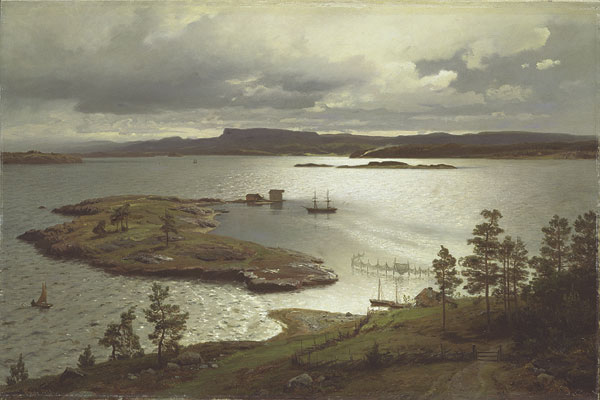
We started out with Nordic landscape painting 1840-1910at the National Museum ofArt(in Stockholm), an exhibition with painters from Sweden, Norway, Finland, Denmark and Island. Some of the paintings from the museum's own collections, some from other museums in Scandinavia. The paintings were organised in five different themes, 'mood'/'atmospheric'-painting, 'the inner landscape' and so forth. From this exhibition we went on to Kulturhuset ("the Cultural Center"/"The Culture House") to see the artist Jin-Sook So, a textile-artist working in different materials and forms. She was born in South Korea but lives in Sweden since 1978, having studying both in Sweden and in her native country.
'The first at Moderna'is the recurring exhibitions the first day of every month at Moderna museet (Museum of Modern Art) where a new artist is introduced, showing some of the works in the presence of the artist her- or himself.
This time it is the Canadian artist Janice Kerbel. For a description of her work, take a look at the link to the museum above.
(Photo painting at the top taken from: http://www.artsmia.org/mirror-of-nature/images/e/cat_024_cd.jpg)
(Photo piece of art, Jin-Sook So, right above taken from: http://www.browngrotta.com/Media/30jss.jpg)
(Photo piece of art Janice Kerbel above taken from: http://www.canadianart.ca/online/see-it/2008/09/25/kerbel2_448.jpg)